

TL;DR:
- Sustainable luxury roses can be ethically sourced with certifications like Florverde, Rainforest Alliance, or Fairtrade.
- Preserved roses offer a more eco-friendly option due to their long-lasting nature and reduced transport needs.
- Modern buyers prioritize both beauty and responsibility, redefining true luxury in floral gifting.
Many assume that luxury roses come at a hidden cost to the planet. The assumption is understandable: roses travel thousands of miles, arrive in elaborate packaging, and disappear within a fortnight. Yet that picture is rapidly changing. Informed buyers are now discovering that the right roses, sourced correctly and chosen thoughtfully, can deliver extraordinary beauty without the environmental compromise. This guide covers the carbon reality of conventional rose production, the power of ethical certification, the case for preserved roses, and exactly how to choose a sustainable luxury floral gift that genuinely impresses.
Table of Contents
- How sustainable are traditional roses?
- Certifications and ethical sourcing: raising the bar
- Preserved vs fresh roses: which is more sustainable for gifting?
- How to choose luxury roses that are truly sustainable
- Why the most meaningful luxury gifts balance sustainability and style
- Discover the OnlyRoses difference: sustainable luxury gifting redefined
- Frequently asked questions
Key Takeaways
| Point | Details |
|---|---|
| Understand environmental impact | Most traditional rose production is energy-intensive or relies on air freight, so the source matters greatly. |
| Prioritise ethical certifications | Certifications like Rainforest Alliance or Fairtrade prove eco-conscious and socially responsible cultivation. |
| Preserved roses offer longevity | Preserved roses yield sustainable elegance for luxury gifts by lasting months or even years. |
| Choose gifts with intent | Align gifting decisions with both presentation and sustainability goals for memorable impact. |
How sustainable are traditional roses?
The answer depends almost entirely on where your roses come from and how they are grown. The carbon footprint of a single rose varies more dramatically than most people realise, and understanding that variation is the first step towards making genuinely sustainable gifting decisions.
Dutch greenhouse roses are among the most carbon-intensive flowers available. Because the Netherlands operates at a northern latitude, commercial rose production depends on artificial heating and lighting throughout the cooler months. Dutch greenhouse roses generate approximately 2.91kg of CO2 per stem, a staggering figure driven almost entirely by energy consumption. That is comparable to boiling a kettle several hundred times for a single bloom.
Kenyan roses present a very different picture during cultivation. Grown in equatorial sunshine with minimal artificial inputs, their production emissions sit at roughly 0.5kg CO2 per rose. However, the journey from Nairobi to London adds between 1 and 1.5kg of CO2 through air transport, narrowing the gap considerably. Neither origin is straightforwardly “green.”
| Origin | Production CO2 per stem | Transport CO2 | Approximate total |
|---|---|---|---|
| Dutch greenhouse | 2.91kg | Minimal (road/sea) | ~3.0kg |
| Kenyan field grown | 0.50kg | +1.0 to 1.5kg (air) | ~1.5 to 2.0kg |
| Ecuadorian high altitude | Variable | +1.0 to 1.5kg (air) | ~1.5 to 2.0kg |
There is also the issue of pesticide regulation. Many rose-producing countries operate under frameworks that permit chemicals banned in the UK and EU. Workers and surrounding ecosystems absorb significant exposure. Understanding what makes roses special as a premium product means also understanding how they are grown, not just how they look upon arrival.
The benefits of fresh roses for gifting are real and well established, but those benefits must be weighed against sourcing realities. Knowing these facts puts you in a far stronger position to gift with both confidence and conscience.
Certifications and ethical sourcing: raising the bar
Certifications are not merely marketing badges. They represent independently verified commitments to environmental and social standards, and they can transform the sustainability story of a fresh rose entirely.
Three certifications carry the most weight in the premium floral industry:
- Florverde Sustainable Flowers focuses specifically on Colombian and Latin American floriculture. Certified farms meet strict criteria around water management, waste reduction, worker health, and biodiversity protection. It is the most sector-specific standard available.
- Rainforest Alliance applies across multiple agricultural industries and prioritises ecosystem preservation, reduced chemical use, and liveable conditions for farm workers.
- Fairtrade centres on economic justice, ensuring that workers and small producers receive fair pay and that a Fairtrade Premium is invested back into community development.
Tangible improvements from these certifications are well documented. Certified rose farms demonstrate measurable reductions in water use, significantly lower pesticide applications, and far better working conditions than uncertified equivalents. These are not incremental gains; in some cases, certified operations have cut chemical inputs by over 50% compared to conventional farms.
| Certification | Primary focus | Key benefit |
|---|---|---|
| Florverde | Latin American floriculture | Ecosystem and worker wellbeing |
| Rainforest Alliance | Broad agricultural scope | Biodiversity and reduced chemicals |
| Fairtrade | Economic fairness | Worker pay and community investment |
When gifting at a luxury level, especially in a business gifting context, the provenance of your roses matters. Clients and colleagues increasingly notice when brands demonstrate genuine ethical awareness, not just attractive presentation.
To identify genuinely ethical roses, look for:
- Clearly displayed certification logos from Florverde, Rainforest Alliance, or Fairtrade
- Supplier transparency about farm origin and country of cultivation
- Evidence of direct or long-term farm relationships
- Packaging that is recyclable or made from responsibly sourced materials
Pro Tip: Ask your supplier directly which certification body audited the farm and when the last audit took place. A reputable brand will answer without hesitation.
Preserved vs fresh roses: which is more sustainable for gifting?
This is where the sustainability conversation becomes genuinely interesting, and where luxury gifting gains a clear advantage.
Fresh roses, even ethically certified ones, have a limited lifespan. Most last between seven and fourteen days under good conditions. That means refrigerated transport, repeat purchases, and repeated air miles for anyone gifting internationally or seasonally. The carbon cost is not a one-time investment; it accumulates with every new arrangement.

Preserved roses are treated through a careful process that replaces the rose’s natural sap with a plant-based glycerine solution. The result is a bloom that retains its texture, colour, and form for many months, sometimes well over a year. No refrigeration. No repeated shipping. No wilting on day ten.
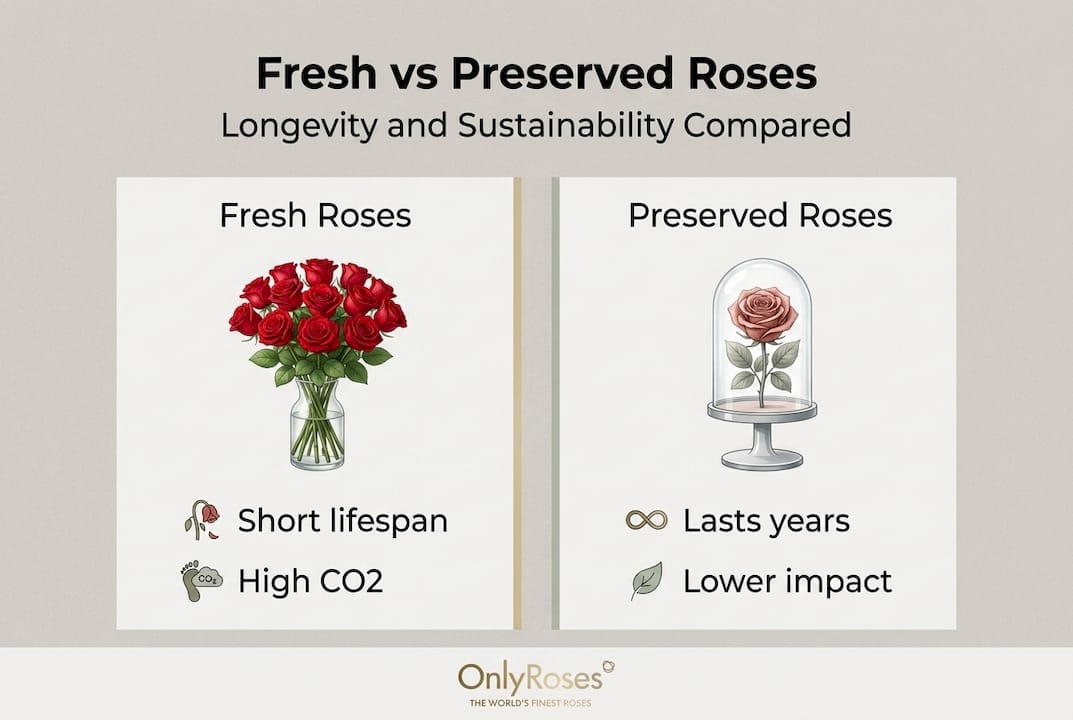
True sustainability in rose gifting balances the appeal of local and seasonal fresh flowers against the enduring environmental advantages of preserved options. For luxury gifts where longevity matters more than scent, preserved roses consistently outperform.
Consider what this means in practice:
- A preserved arrangement shipped once can be enjoyed for twelve months or longer
- No weekly fresh flower purchases are needed to maintain impact
- Recipients in different cities or countries receive the same impeccable quality without compromised freshness
- Preserved roses are available in a full spectrum of colours year-round, independent of growing seasons
The contrast between preserved and fresh roses is not simply about longevity. It is about what preserved roses represent as a gifting philosophy: deliberate, lasting, and deeply considered. For those exploring unique gifting ideas beyond the conventional bouquet, preserved roses in a signature hat box offer something the recipient will keep, not discard.
Fresh roses remain the right choice when locally sourced, seasonally appropriate, and delivered with minimal transport involved. For anything else, preserved roses are the more responsible and more impressive option.
How to choose luxury roses that are truly sustainable
Selecting genuinely sustainable luxury roses requires a shift from instinct to intention. The most beautiful arrangement is not always the most responsible one, but with a little knowledge, the two are easily reconciled.
Follow this approach when making your selection:
- Prioritise certifications for fresh roses. If you are gifting fresh flowers, verify that they carry Florverde, Rainforest Alliance, or Fairtrade certification. These certified standards are the clearest signal that production meets meaningful environmental and social benchmarks.
- Choose preserved for lasting impact. For corporate gifts, milestone occasions, or any gift intended to endure, preserved roses eliminate repeat sourcing and transport entirely.
- Ask about supply chain transparency. A supplier committed to sustainability will tell you exactly where their roses were grown and how they were treated.
- Assess the packaging. Truly luxury roses need not come with excess plastic or non-recyclable materials. Elegant, minimal packaging is both more sophisticated and more responsible.
- Match the gift to the occasion. A fresh bouquet for a birthday celebration feels immediate and joyful. A preserved arrangement for a corporate anniversary communicates permanence and thought.
Pro Tip: For luxury gifting occasions where presentation is everything, choose a brand that offers both certified sourcing and refined packaging. The combination signals exactly the level of care your recipient deserves.
Why the most meaningful luxury gifts balance sustainability and style
There is a persistent assumption in premium gifting that environmental responsibility requires aesthetic sacrifice. We would challenge that firmly. In our experience, the opposite is true.
The buyers redefining luxury today are not choosing between beautiful and responsible. They are insisting on both, and the market is responding. Preserved roses presented in a minimalist hat box with gold detailing are not a compromise. They are a statement. They say that the giver considered the planet as carefully as they considered the presentation.
What often gets overlooked in this conversation is the emotional depth that conscious gifting creates. When a recipient learns that their gift was sourced from an ethically certified farm, or that their preserved roses will last an entire year without wilting, the gesture becomes layered with meaning. It is no longer simply beautiful. It is thoughtful in a way that feels rare.
Eternal roses exemplify this perfectly. They are not lesser versions of fresh flowers. They are a distinct, elevated product that lasts far longer, requires no care, and carries a smaller ongoing environmental footprint. For the discerning gift buyer, they represent exactly what modern luxury should be: intentional, beautiful, and built to endure.
The shift is already happening among those who understand that provenance, ethics, and longevity are not extras. They are the new definition of premium.
Discover the OnlyRoses difference: sustainable luxury gifting redefined
At OnlyRoses, we believe that the finest roses should be grown responsibly and presented impeccably. Our curated collections bring together high-grade Ecuadorian roses with the craftsmanship and packaging detail that makes gifting genuinely memorable.
Whether you are discovering our luxury roses guide for the first time or exploring preserved roses as a sustainable alternative to fresh flowers, we offer full transparency on sourcing and a presentation standard that speaks for itself. Our preserved roses can last for months with virtually no maintenance. Find out exactly how long preserved roses last and how to care for them so your gift remains as striking in six months as it was on arrival.
Frequently asked questions
Are preserved roses more eco-friendly than fresh roses?
Preserved roses are often more sustainable for luxury gifting as they last significantly longer and reduce the need for repeated air-transported shipments, lowering the cumulative carbon footprint over time.
What certifications should I look for when buying sustainable roses?
Look for Florverde, Rainforest Alliance, or Fairtrade certification, each of which reflects independently verified social and environmental standards in rose production.
Do Kenyan roses have a lower carbon footprint than Dutch ones?
Kenyan roses produce far less CO2 during cultivation, but air transport adds 1 to 1.5kg per stem, which can significantly reduce the advantage over Dutch greenhouse roses depending on the final destination.
Can luxury and sustainability coexist in floral gifting?
Absolutely. By choosing ethically sourced or preserved roses with premium presentation, you deliver a gift that combines exceptional beauty with a genuinely responsible approach to gifting.

