

TL;DR:
- Proper rose care, including sharp cuts, flower food, and refrigeration, significantly extends their lifespan. With optimal handling, premium roses can last up to 15 days, maintaining freshness and beauty for important occasions. Consistently following these expert tips ensures your blooms remain vibrant and impactful longer.
There are few things more disheartening than receiving a stunning arrangement of premium roses, only to watch them droop and fade days before the occasion you had in mind. Whether you’re gifting a luxury bouquet for a birthday, anniversary, or proposal, the beauty of high-grade roses deserves to last. This guide gives you everything you need: the right tools, a proven care routine, expert-level tricks, and clear expectations for how long your roses should thrive with the right attention.
Table of Contents
- What you’ll need to extend rose lifespan
- Step-by-step: How to prepare and display your roses
- Boost rose longevity: Essential tips and clever shortcuts
- How long do premium roses last? What to expect and verify
- A London gifting perspective: Beyond the basics of rose care
- Premium roses, extended beauty: Explore your options
- Frequently asked questions
Key Takeaways
| Point | Details |
|---|---|
| Fresh diagonal cut | Trim rose stems at a 45-degree angle for optimal water absorption and longevity. |
| Clean vase and water | Clean your vase and replace water every two days to reduce bacteria and maximise rose life. |
| Flower food is essential | Flower food or a sugar-citric acid mix supports rose health far beyond plain water. |
| Refrigerate for events | Overnight refrigeration boosts freshness for important occasions without freezing the roses. |
| Watch for signs | Healthy roses should remain upright and vibrant if these steps are followed. |
What you’ll need to extend rose lifespan
To ensure success, first gather everything you’ll need before handling your premium roses. Having the right materials to hand makes the difference between blooms that last a week and those that last nearly a fortnight.
Here is what you’ll need before you begin:
- Sharp scissors or a floral knife for a clean diagonal cut
- A clean glass or ceramic vase (free of soap residue or old flower debris)
- Cool, clean water (not tap water that’s been sitting warm)
- Flower food sachets (usually included with premium arrangements)
- A lint-free cloth for wiping stems if needed
- A refrigerator with space for overnight storage, ideally away from fruit
Each item serves a specific purpose. Sharp scissors prevent crushing the stem’s vascular tissue, which would restrict water uptake. A spotless vase eliminates the bacterial colonies that are one of the leading causes of early wilting. Flower food combines a sugar for energy, an acidifier to lower pH and improve water absorption, and a biocide to slow bacterial growth.
| Item | Why it matters | Without it |
|---|---|---|
| Sharp scissors | Clean cut keeps vascular tissue open | Crushed stems block hydration |
| Clean vase | Reduces bacterial contamination | Accelerated decay |
| Cool water | Slows bacterial growth | Faster wilting |
| Flower food | Feeds blooms and inhibits bacteria | Shorter vase life |
| Refrigerator | Slows cellular respiration overnight | Blooms age faster |
As part of learning how to prepare roses for delivery, starting with the right toolkit is the first non-negotiable step. And if you want deeper context on maximising your gift’s impact, our rose gifting longevity guide is an excellent companion read.
According to the horticultural advice from Better Homes & Gardens, a fresh diagonal stem cut at approximately 45 degrees, followed by immediate hydration, is the single most important step you can take for cut rose longevity.
Step-by-step: How to prepare and display your roses
Once you have your supplies ready, follow this proven sequence for maximum freshness.
-
Unpack carefully and keep cool. Open your arrangement in a cool room, away from direct sunlight or heating vents. If the box feels warm from transit, let it rest in a cooler space for 10 minutes before unwrapping fully.
-
Trim stems at a diagonal. Using sharp scissors or a floral knife, cut approximately 2 to 3 centimetres from the base of each stem at a 45-degree angle. Do this under running water or while submerging the stems in a bowl to prevent air bubbles entering the cut.
-
Hydrate immediately. Place trimmed stems directly into cool water. Every second the cut end is exposed to air increases the risk of an air embolism forming in the stem, which will stop water reaching the bloom.
-
Remove leaves below the waterline. Strip any foliage that would sit beneath the surface. Submerged leaves decompose quickly and reduce bacterial growth when kept above the waterline.
-
Add flower food and follow the packet instructions precisely. The ratio matters. Too little flower food has minimal effect; too much can burn the stems. Research published in the BioChem Journal confirms that specific vase solutions extend rose longevity significantly over plain or distilled water alone.
-
Arrange in a clean vase with cool water. Position your roses with space between each stem. Crowding traps heat and humidity around petals, accelerating petal drop.
-
Refrigerate overnight if your event is the following day. This is the single most effective trick for event-day perfection.
Pro Tip: If you are arranging roses into a vase from a hatbox delivery, follow our dedicated rose delivery preparation guide before rearranging, as the conditioning steps are slightly different from a standard bouquet.
| Step | Purpose | Best practice |
|---|---|---|
| Diagonal trim | Opens stem for hydration | Cut underwater when possible |
| Remove submerged leaves | Reduces bacterial load | Remove all foliage below water |
| Add flower food | Feeds and protects blooms | Follow sachet ratios exactly |
| Cool-water vase | Slows bacterial growth | Change water every two days |
| Refrigerate overnight | Slows cellular ageing | Keep above 2°C, away from fruit |
For those who want to take their presentation further, our guide on how to arrange a luxury bouquet covers spiralling, colour layering, and professional display techniques.
Boost rose longevity: Essential tips and clever shortcuts
Now let’s focus on expert-level strategies to elevate results and sidestep common mistakes.
Flower food is not optional. It works through three mechanisms: the sugar fuels the bloom’s cellular activity, the acidifier lowers the pH of the water to improve absorption, and the biocide kills bacteria before they can form the slimy residue you sometimes see on stems. The flower food formula is a genuine piece of postharvest science, not a marketing gimmick.
Refrigeration is your secret weapon. Placing the entire vase arrangement in the refrigerator before bed and returning it to display in the morning is one of the most impactful things you can do for event-day freshness. The cool temperature significantly slows the respiration rate of the blooms, preserving petal texture and colour depth. Just ensure the temperature stays above freezing.
Common mistakes that shorten rose life:
- Placing roses near fruit bowls (ripening fruit emits ethylene gas, which accelerates wilting)
- Leaving roses in direct sunlight or near a south-facing window
- Forgetting to change the water, allowing bacteria to multiply rapidly
- Using a vase that was not thoroughly cleaned between uses
- Storing roses near radiators, open fires, or draughty windows
Pro Tip: If you do not have flower food, a reliable home alternative is a solution of one teaspoon of sugar, one teaspoon of white vinegar, and a few drops of household bleach per litre of water. The sugar feeds the bloom, the vinegar acidifies the water, and the bleach acts as a basic biocide.
Critical rule for event success: Refrigerate your roses the night before your special occasion. Even one night of cold storage can extend petal integrity by 24 to 48 hours, meaning your blooms look their absolute best at the exact moment they matter most.
Our guide to sending premium roses also covers how to time your delivery order to align with your event, which works hand in hand with these care steps.
How long do premium roses last? What to expect and verify
But how long should you expect these care routines to work, and what signals should you look for?
With no care at all, cut roses placed in plain water can last as little as 6 days. With optimal care, including proper cutting, flower food, and refrigeration, vase life can reach approximately 15 days. That is a significant difference, particularly when you are planning around a specific date.
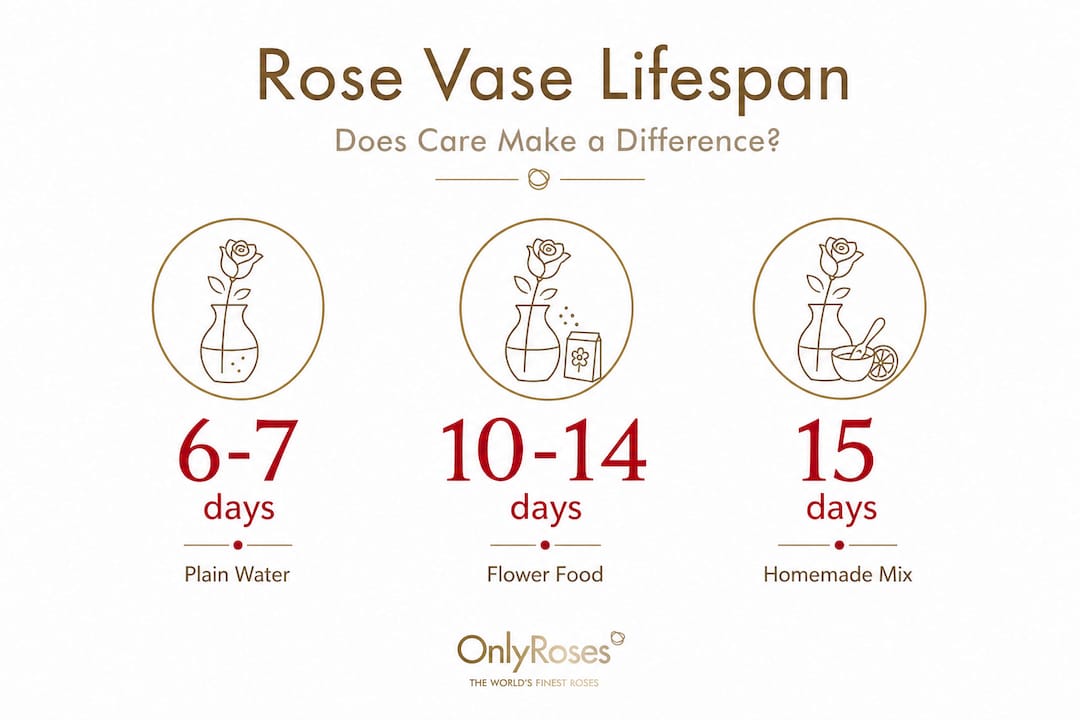
| Care method | Average vase life | Notes |
|---|---|---|
| Distilled or plain water only | 6 to 7 days | Bacteria build up quickly |
| Commercial flower food | 10 to 12 days | Best results with clean vase |
| Citric acid and sucrose solution | Up to 15 days | Closest to commercial flower food |
| Refrigeration added | Extra 1 to 2 days | Best for event-day planning |
You can learn more about aligning these results with your gifting needs through our notes on expected rose lifespan.
Signs your roses are thriving: petals remain tightly furled or gently open, stems are firm and upright, water remains fairly clear, and fragrance is present.
Signs of deterioration to watch for: drooping necks (the bend just below the bloom), browning outer petals, cloudy water with an unpleasant smell, or slimy stems. At the first sign of decline, recut the stems, change the water completely, and add fresh flower food.
A London gifting perspective: Beyond the basics of rose care
What we have observed serving London’s most discerning clients over the years is that the gap between a good gift and an unforgettable one almost always comes down to timing and temperature. Most people understand that roses need water. Fewer understand that the 12 hours before an event are the most critical window of all.
London’s climate creates a specific challenge. Centrally heated flats, draughty hallways, and the humidity shifts between tube journeys and outdoor cold mean your roses are working harder than they would in a controlled environment. The overnight refrigeration step is not a nice-to-have in this city; it genuinely pays off in a way that matters visually on the day.
There is also a mindset shift worth considering. Premium roses represent an investment, both financially and emotionally. Treating them as a luxury product, with the same attention you would give fine wine or a tailored suit, transforms the entire gifting experience. A rose that is still at its peak on the evening of an anniversary dinner delivers an emotional impact that a wilting one simply cannot.
For those seeking inspiration before ordering, our collection of luxury bouquet ideas showcases arrangements that are designed specifically with longevity and occasion-readiness in mind.
The one actionable hack we recommend to every busy Londoner: order your roses two days before the event, condition them on day one, refrigerate on day two, and display on the morning of the occasion. That rhythm works consistently.
Premium roses, extended beauty: Explore your options
Now that you can make roses last longer, take your gift-giving to the next level with curated premium selections.

At OnlyRoses, every arrangement is designed with longevity and occasion-readiness in mind. From our signature Ecuadorian blooms with their exceptional stem length and petal density, to our preserved roses that maintain their softness and appearance for months, there is an option perfectly suited to every significant moment. Whether you are searching for a classic red arrangement or an exploration across our palette of over thirty colours, our collections translate your newfound care knowledge into gifts that genuinely last. Browse our full range and find the arrangement that matches your occasion at only-roses.co.uk.
Frequently asked questions
How often should I change the water in my rose vase?
Change the water every two days to keep roses fresh and prevent the bacterial build-up that causes early wilting, as clean water is essential to reducing decay.
What is the ideal temperature for storing roses overnight?
Keep roses between 2 and 7°C to maximise freshness; the recommended refrigerator range ensures blooms stay above freezing while slowing cellular ageing overnight.
Can I use homemade solutions instead of flower food?
Yes. Research shows that citric acid with sucrose can extend vase life to approximately 15 days, making it a strong alternative to commercial sachets.
Why do roses droop even after fresh-cutting?
Drooping typically signals that bacteria or an air pocket is blocking the stem’s water uptake. Recut the stems, replace the water entirely, and return the vase to a cool location to restore hydration.

